
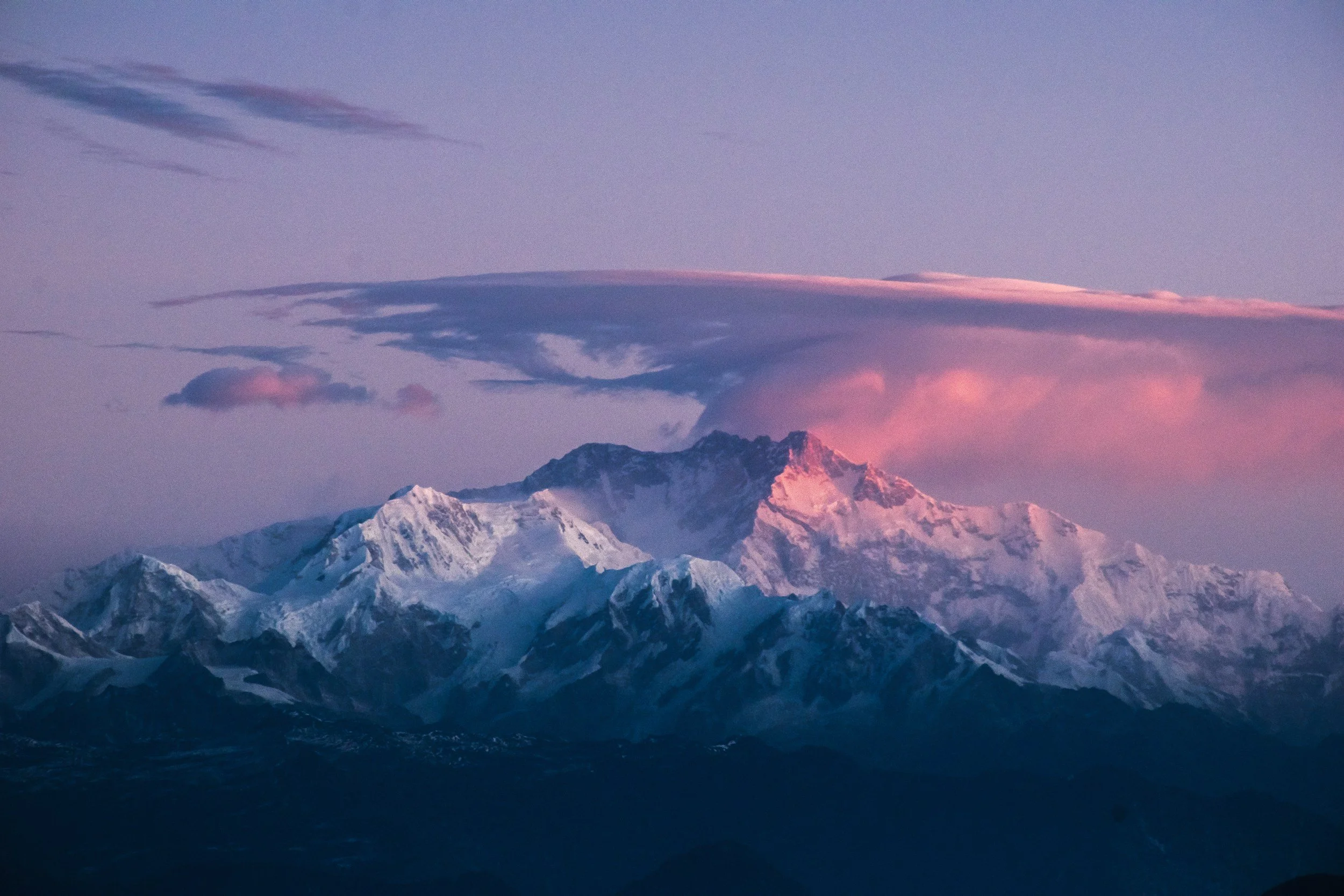
The world’s third highest mountain — on a route its founder pioneered
Kangchenjunga (8,586m) sits on the border between Nepal and Sikkim, and it stands entirely apart from the trekking crowds that fill the Everest and Annapurna corridors. This is genuinely remote Nepal — the far east of the country, pristine, wild, and visited by very few trekkers in any given year.
The mountain is sacred to the Lepcha people and to Tibetan Buddhists, who regard its five summits as housing sacred elements — gold, turquoise, salt and precious minerals. Out of respect for these beliefs, no climber has ever set foot on the true summit. Kangchenjunga is the mountain that stops at 8,586m by choice.
CAT’s route visits both North Base Camp (Pang Pema, 5,139m) and South Base Camp (Oktang, 4,624m), crossing the high Mirgin La pass between the two. It is a serious undertaking involving some of the most remote trekking terrain in Nepal — but it delivers an experience that is utterly unlike anything else on offer.
This is also the only trek in Nepal that follows a route opened by Doug Scott himself. In 1979, Doug’s team pioneered the approach to Kangchenjunga’s north base camp. That route is the one we still run today.
Your Kangchenjunga booking includes a £50 direct donation to Community Action Nepal. The far-eastern communities you pass through — many of them without road access — are among the most isolated in Nepal. Your presence and your booking matters here.
Land only · flights not included
Includes £50 CAN donation
Kangchenjunga runs on your dates for your group. Minimum 4 trekkers. Spring (March–May) and autumn (October–December) both excellent. Enquire and we’ll confirm availability within 24 hours.
Enquire & Book Book a Free CallNo technical climbing required. This is a demanding high-altitude trek, not a mountaineering expedition. Serious fitness and altitude experience required.
Doug Scott’s 1979 expedition to Kangchenjunga was the first ascent of the mountain via the north ridge — and in preparing for it, his team opened up the trekking route to the north base camp for the first time. Forty-five years later, that is still the route CAT uses. When you trek to Pang Pema with us, you walk in the footsteps of the man who founded this company and opened this valley to the outside world. There is no other trek in Nepal where that can be said with the same truth.
Kangchenjunga in numbers
The route visits both the North Base Camp at Pang Pema (5,139m) and approaches the South Base Camp via Oktang (4,624m), crossing the Mirgin La (4,640m) between them. Most other operators only visit one.
Unlike the other CAT Summit peaks, Kangchenjunga is a pure trek — no crampons, ice axe or technical skills required. What it demands instead is outstanding fitness, altitude tolerance and a willingness to operate in genuinely remote terrain.
For nearly a week at a time you are in country with no road access, very limited phone signal, and no straightforward evacuation option. The Kangchenjunga region retains its pristine character precisely because it sees so few visitors.
The Kangchenjunga Conservation Area is home to snow leopards, Himalayan black bears, musk deer, red pandas and nearly 30 species of rhododendron. In spring the flower spectacle is extraordinary. In autumn the air is crystalline.
Unlike the other trekking peaks, Kangchenjunga is predominantly a lodge trek — no camping equipment required until the highest sections. This is unusual for a trek of this altitude and adds to the accessibility of the experience.
Kangchenjunga was considered the highest mountain on earth until 1852. Sacred to the Lepcha and Buddhist communities — out of respect, no climber has ever stood on its true summit. You stand at its base and look up. It is enough.
29 days into Nepal’s most remote corner
Welcome meeting, permits, kit checks. Free day to explore Kathmandu.
Arrival45-minute flight to Bhadrapur, 6-hour drive to Phidim. Gateway to the far east of Nepal.
1,264mMeet the porters at Taplejung. Ridge trail to Lali Kharka, then through Tambawa, Pakora and Funfun village — first distant views of Kangchenjunga and Jannu (7,710m).
1,735m → 2,445mCross the Lamite Bhanjyang (3,430m). Descend to the Simbua river valley. Essential acclimatisation day at Thoronton with height-gain walk.
2,995mRhododendron forest thins to give views of Kabru (7,338m) and Talung (7,349m). Reach the Yalung Glacier at Ramze. Acclimatisation walk toward the south face of Kangchenjunga.
3,890m → 4,110mAfternoon preparation at Yalung before the long climb to the Mirgin La (4,640m) — highest point of the route. Spectacular views of Jannu, Makalu and the Tibetan border mountains.
4,640m High PassDescend through rhododendron to the Sherpa village of Ghunsa. Climb to Kambachen with views of Jannu above. On to Lhonak beyond the Kangchenjunga glacier — Tent Peak, Nepal Peak and Wedge Peak all visible.
3,414m → 4,700mThe North Base Camp at 5,139m. A vast cirque formed by Yalung Kang (8,505m), Kangchenjunga (8,586m), The Twins and Cross Peak. Exploration and contingency day here.
5,139m — North BCRetrace the route down through the Kangchenjunga glacier valley. Monkey troops in the dense forests of Gyapla. A journey never quite the same in reverse.
DescentLong descent through cultivated land and cascading river valleys. Final trek to Taplejung where the road begins again.
1,270m → 1,820m9-hour drive to Biratnagar, evening flight to Kathmandu. Final day exploring the city, celebration dinner and departure.
ReturnDetailed day-by-day itinerary provided on enquiry. One contingency day built in at North Base Camp.
Everything taken care of
- 4 nights hotel in Kathmandu on arrival & departure
- Return internal flights: Kathmandu ↔ Bhadrapur/Biratnagar
- All road transfers throughout
- All lodge accommodation throughout the trek
- Full board — all meals from start of trek to return
- Expert Sherpa lead guide throughout
- Assistant guides depending on group size
- All porterage — 15kg per person carried daily
- All trekking permits and restricted area permits
- Kangchenjunga Conservation Area fees
- All Nepali staff insurance
- Group first aid kit and emergency oxygen
- £50 Community Action Nepal donation per person
- Pre-departure information pack and kit list
What to budget for
- International flights to/from Kathmandu
- Nepal visa (approx. US$50, on arrival)
- Travel insurance (mandatory, must cover helicopter evacuation)
- Personal spending, tips and souvenirs (allow £250)
- Meals other than breakfast in Kathmandu
- Alcoholic drinks and personal snacks on trail
- Emergency evacuation costs (covered by your insurance)
No technical equipment needed. Kangchenjunga is a pure trekking itinerary — no crampons, ice axe or harness required. Good waterproofs, warm layers and a quality sleeping bag (−10°C rated minimum) are essential.
Kangchenjunga is priced at £3,695pp land only — reflecting the remote location, internal flights and extended 29-day itinerary. Fill in the form and we’ll come back within 24 hours with availability and a full briefing pack.
No commitment at enquiry stage
No technical climbing required — but strong fitness and altitude experience essential
Minimum 4 trekkers — solo enquiries welcome
Both spring and autumn windows available
The only operator running this route with 35 years of Sherpa expertise
Our team will come back within 24 hours with availability and a full Kangchenjunga briefing pack. Email hello@catreks.com if it’s urgent.